

Oral history
Thousend of interviews led to many productions
Once upon a time
There was a time when families were large, homes were small, and the entire family gathered around the coal stove during long winter evenings. If the game of goose remained in the cupboard, stories were told on such nights. Stories shared by parents and grandparents with their children and grandchildren—tales of harsh winters, radiant summers, poverty, values, love, and happiness. In short, for centuries, storytelling was the primary means through which culture, in its broadest sense, was passed down.
With the advent of central heating (the first major culprit) and audiovisual media, the role of storytelling within the home as a cultural carrier has come under pressure in recent decades. Books, films, computers, and magazines have become formidable competitors to what scholars term "oral history." This development is lamentable for many reasons. The most significant is that storytelling forms the foundation of virtually every art form. Art can be seen as a "meta-story" of a society—an individual expression that transforms the collective essence of stories into a new and unique form. If the wellspring of stories runs dry, art is directly endangered.
BT is an artist who, in her recent work, builds a remarkable bridge between the authentic story—as it was once told by grandparents to their grandchildren around the coal stove—and the "meta-story" that emerges in a work of art, crafted from a canon of shared tales. In works such as Anno MM (Memento Mori) and Anno Drenthe, she figuratively places the coal stove on stage: ordinary elders share personal stories from their lives. Yet, instead of doing so in the intimacy of their homes, they do so on stage. In this way, T restores the connection between orally transmitted stories as primary cultural carriers and the artistic expressions these stories inspire. The source and the cultural expression merge:
The oral story itself becomes "art."
This dual-layered storytelling offers the audience at least two narratives simultaneously: the primary stories as told by those who lived them, and the story BT tells through her selection, staging, and sequencing of those tales. Viewed and listened to this way, oral history presented on stage is not only an artistically engaging experiment but also a fascinating exploration of the story as a cultural artifact, rising and falling in prominence. While one might label this interplay as "incestuous," the stage, as an artistic substitute, can revitalize the original source—the coal stove—when it risks fading away.
In a society where diverse cultures increasingly share a small geographic space in pursuit of harmonious and inspiring coexistence, the role of passing on one’s own stories cannot be overstated. The ability to share one's story and experience others' interest in it is a vital key to the recognition of each individual's identity and equality, both personal and collective. Put differently: the willingness to listen to each other's stories is a measure of the equality of the individuals and cultures that lie behind them. Theater offers a unique platform for engaging with this socially significant reality.
"Bring tonight stories
That the war has vanished.
Tell them a hundred times,
And every time, I will weep."
(Leo Vroman)
The roots of art: Stories as cultural anchors by Marnix Koolhaas (VPRO Radio)
Betsy Torenbos invites elderly individuals to share their stories in theater, returning to the very origins of art. Preserving and transmitting experiences has always been one of humanity’s primary tasks. In ancient times, there was no other way to achieve this but through storytelling. Those with life experience gathered the young around them at appointed times to share the lessons they had learned—often stories they themselves had inherited from earlier generations. The goal was to ensure these stories endured. To achieve this, they had to meet certain criteria: a musical structure was important, involving repetition, rhythm, and tone. Vivid imagery and compelling comparisons helped bring the stories to life. Dramatic reenactments of key moments further enhanced their impact. From these traditions of storytelling, theater emerged.
Today, storytelling is no longer the sole method of transmitting experiences. Methods have evolved that reach far wider audiences and minimize errors in transmission. As a result, age and life experience have become less central to cultural continuity. Elders are no longer the primary custodians of history for the young. In fact, in a culture no longer dependent on oral transmission, a dynamic has emerged that favors constant renewal. In such a culture, the young hold an advantage over the old, as they more readily embrace innovation.
Against this backdrop, giving a voice to the elderly is a noteworthy initiative. Their stories are no longer essential for cultural continuity, as other means guarantee the connection to the past. Often, they recount matters that seem irrelevant in today’s society. The circumstances of daily life have changed so dramatically. Yet, this very irrelevance imbues their stories with urgency and significance. They highlight the passage of time, offering a poignant sense of perspective. In a society undergoing relentless change, these stories have a grounding effect, essential for a nuanced understanding of human life.
By Kees Vuyk (Philosopher / Former director, Theater Institute Netherlands)
Caecilia and Louis Andriessen in 2015 en 2016
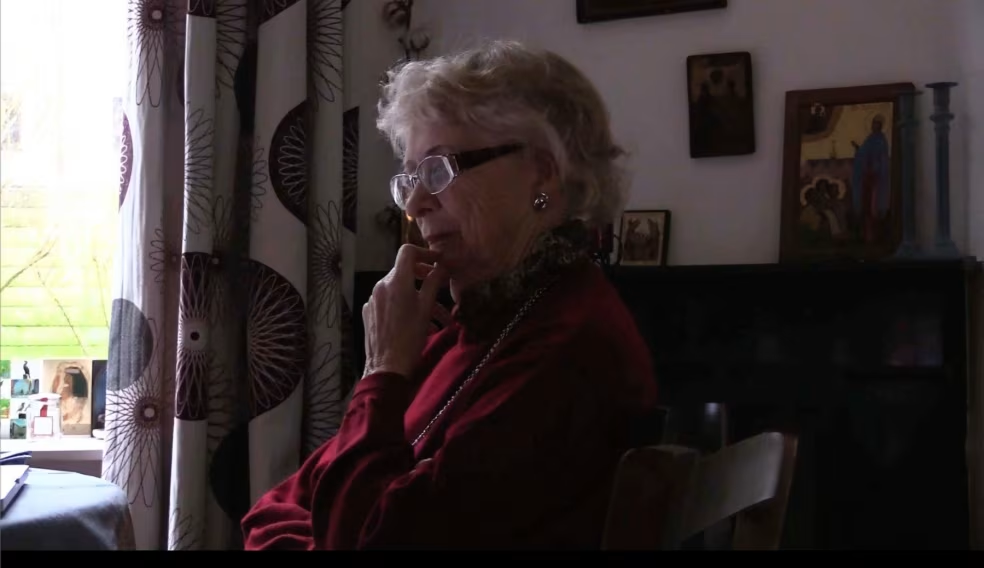
Caecilia Andriessen is listening to Louis' interview
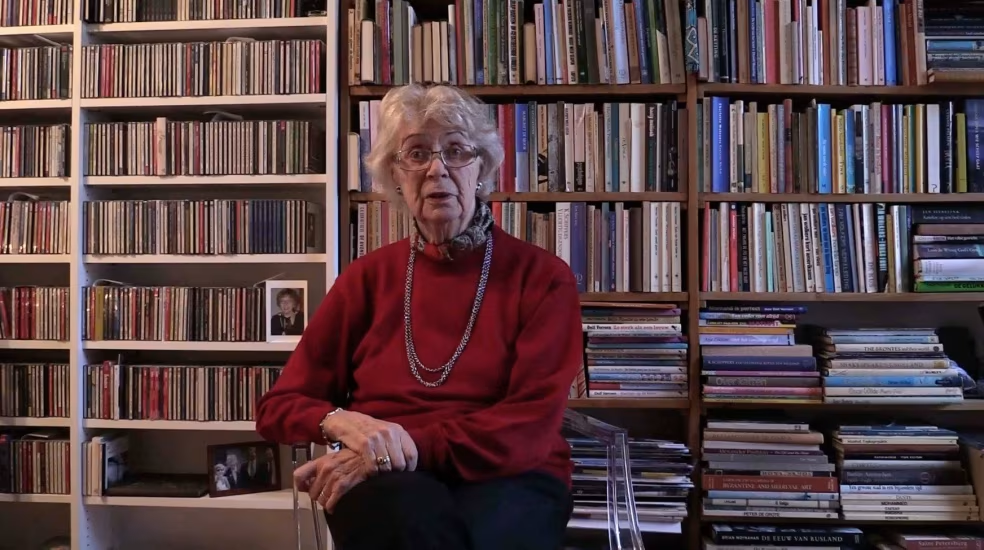
Caecilia Andriessen in 2016
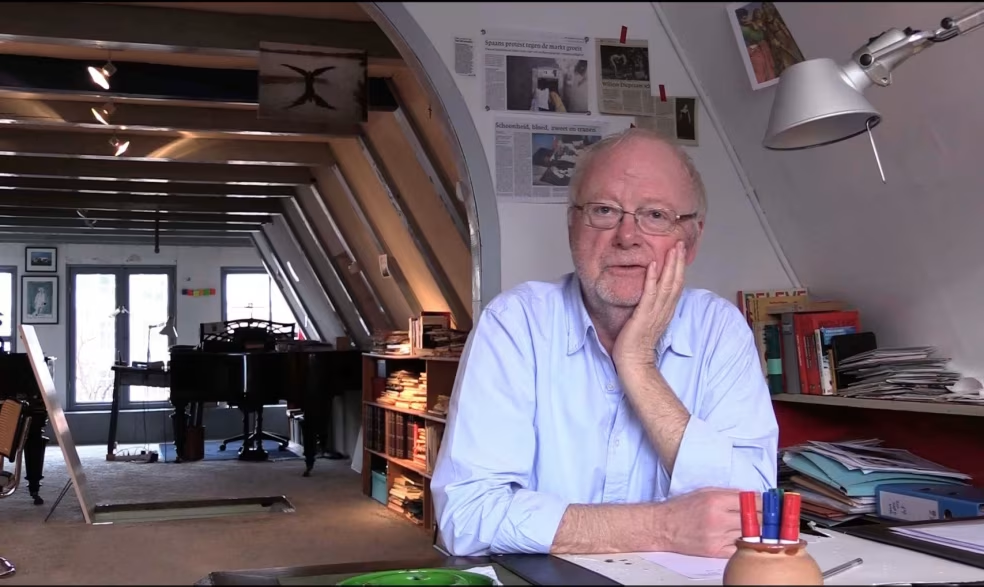
Louis Andriessen speaks about his childhood in 2015
 Copyright 2026 Stichting Be-wonder