
TNG
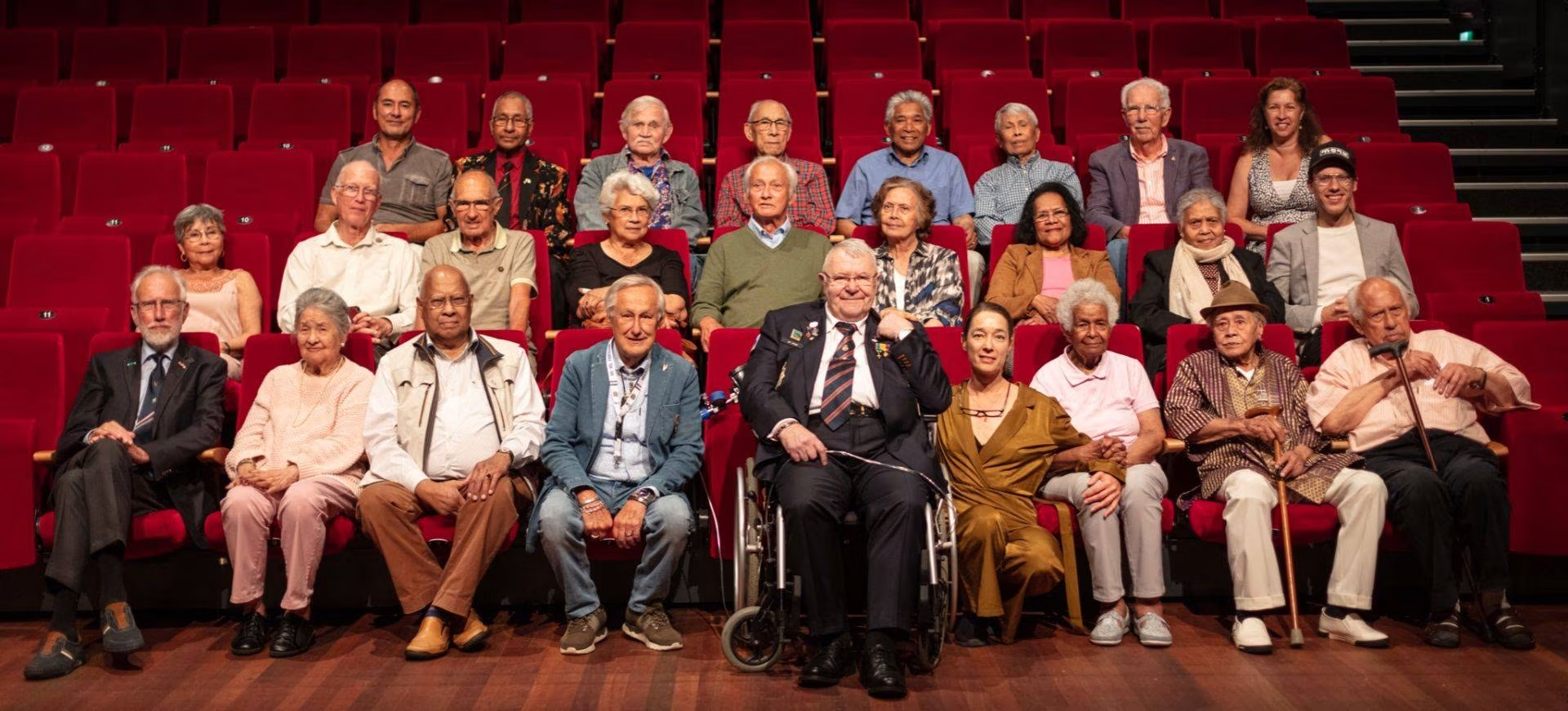
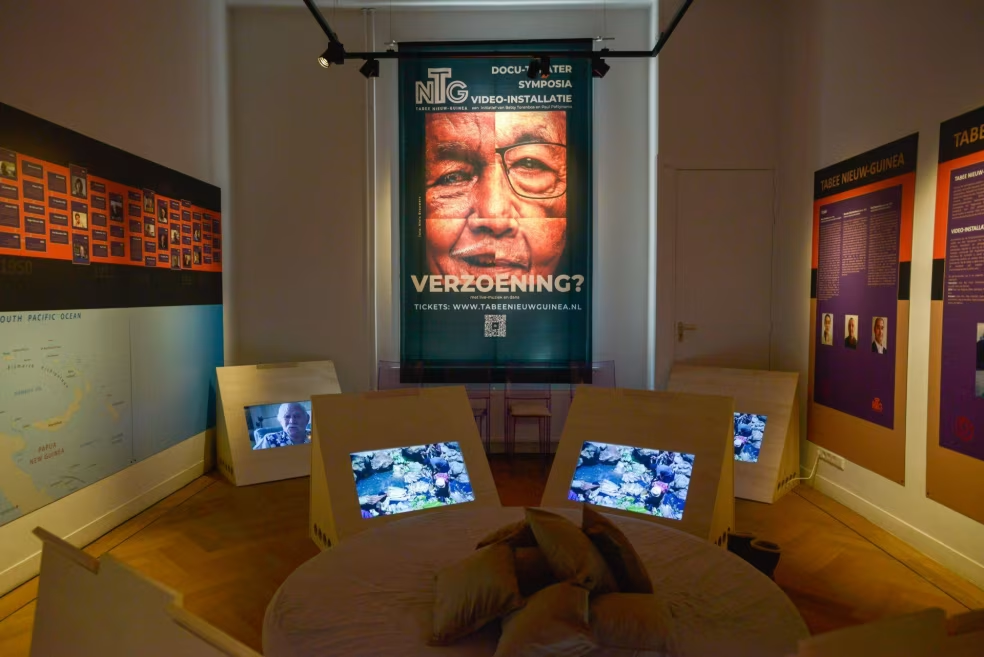
Tabee Nieuw-Guinea
VIMEO LINKS INTERVIEWS + BIO's
https://vimeo.com/933229041 FRANS DE SERA
https://vimeo.com/1039993174 EFRAT MAMORIBO
https://vimeo.com/1039604398 JANE FÜREN
https://vimeo.com/1039610427 HILLY FREDRIKSZ
https://vimeo.com/1039599047 ANNIS LEKRANSY
https://vimeo.com/1039810122 RANNY HERKLOTS
https://vimeo.com/1039797839 PIET VAN MENSFORT
https://vimeo.com/1039822690 MARINUS MARESCH
https://vimeo.com/1039697390 NICO VAN BALGOOY
https://vimeo.com/1039666030 JACQUES DE JONGE
https://vimeo.com/1039649307 JAN HERMAN VAN ROYEN
https://vimeo.com/932886013 DAAN SAHETAPY
https://vimeo.com/1039368400 SIEM NIEUWENHUIJSE
https://vimeo.com/1038891211 FLOOR HOOGENBOOM
https://vimeo.com/1039376996 LENIE BOS
https://vimeo.com/1039420166 HENK BOSMAN
https://vimeo.com/1039385383 HETTY SCHEEPE
https://vimeo.com/1039432628 FRANS PEERELAND
https://vimeo.com/1039423668 HEIDIE HEINTZ
https://vimeo.com/1039435126 FRANS SAUSELE
https://vimeo.com/1039446904 IEN en BURMANUS WENNO
https://vimeo.com/1038694333 EDDY KORWA
https://vimeo.com/1038703161 MIEK DORRESTEIN
https://vimeo.com/1038733195 LIZZY SCHRIJN
https://vimeo.com/1038747738 GERRIT ABRAHAMS
https://vimeo.com/1038752597 CORRIE AP
https://vimeo.com/1039000550 AREND POTTJEGORT
https://vimeo.com/1039027849 RENEE HOKSBERGEN
https://vimeo.com/1039275424 ALEX BAL
https://vimeo.com/1039631377 HANS VAN ZANTEN
https://vimeo.com/1039637198 FRED VAN DER BURG
FRANS DE SÉRA
Frans de Séra (Radjapolla, 1931) left for Hollandia at the age of 19 as a DETA contractor. The journey was by ship via Semarang and Surabaya, where other DETA contractors were picked up. On the way to Makassar, everyone stood on the aft deck to watch Java disappear behind the horizon. In Sorong, where they made a stopover, he and the other DETA boys were immediately put to work unloading the cargo intended for Sorong. Right after his one-year DETA contract, Frans worked for the Public Works Service of New Guinea (DONG). Later he worked at the Hydrographic Service in Merauke. In October 1962, Frans left for the Netherlands.
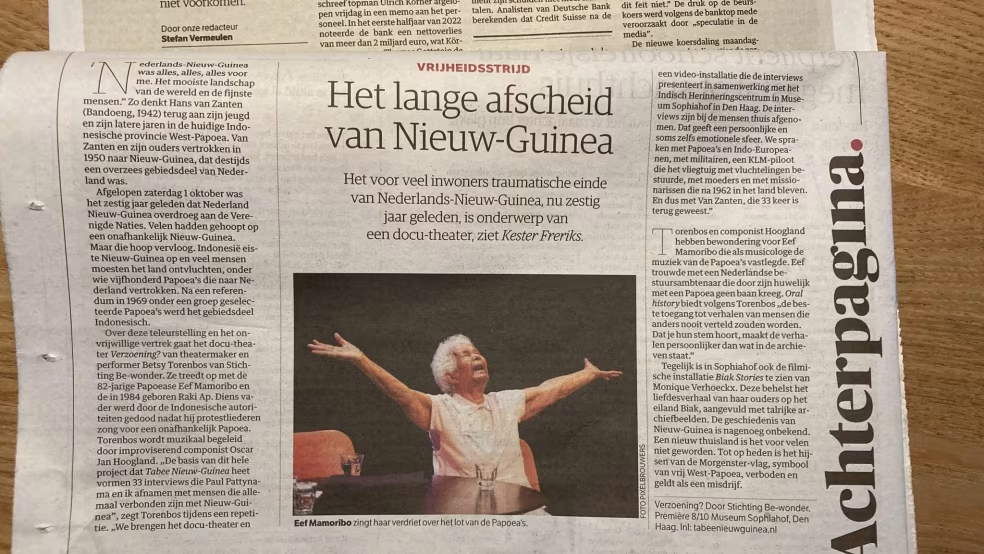
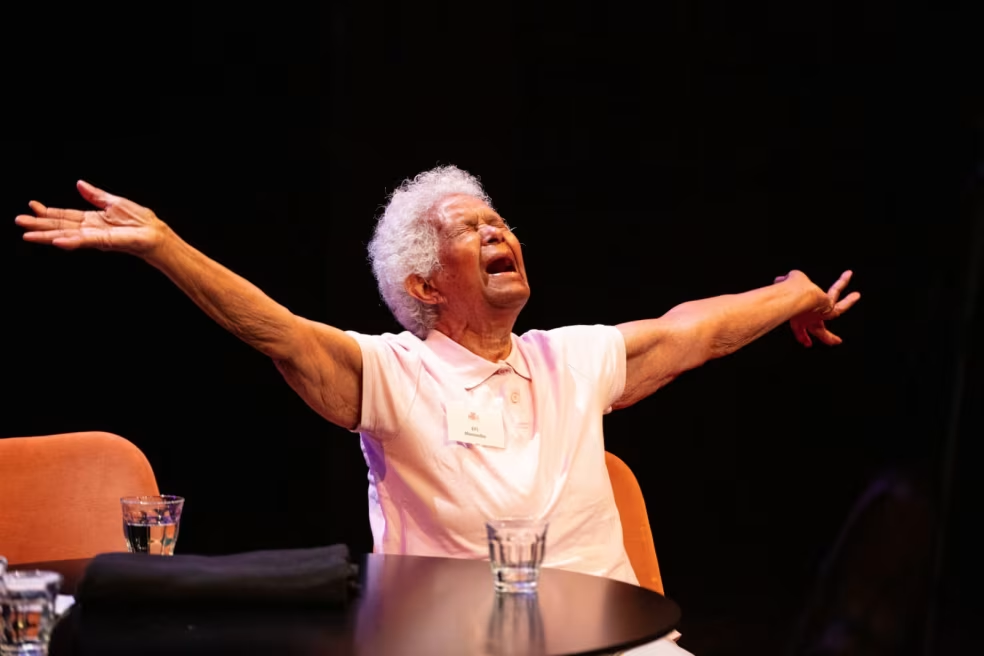
EFRAT MAMORIBO
Eef Mamoribo (Warsa, 1940) grew up in Biak in a stilt house by the sea. From 1978 to 2007 she was a singer with the dance and singing group Sampari. Eef married the Dutch administrative officer Han Carels. Because he married a Papuan woman, he lost his job, something that saddened Eef at the time. In July 1962, Eef went on leave to the Netherlands with three children. When in August 1962 it became known that New Guinea would be handed over to Indonesia, Eef and her family were unable to afford the return journey. It wasn’t until 1974 that she could visit New Guinea again for the first time, as Papuans were not allowed to return until 1970. She never saw her father again.
JANE FÜREN
Jane Füren (Soebang, 1938) arrived in Sarmi, New Guinea, in 1951 as a 12-year-old girl with her mother. Her father had been killed by the Japanese. Her grandparents had already moved to New Guinea in 1948. Through mediation of the World Council of Churches, she was placed with a Dutch foster family in Hollandia-Binnen at the end of 1952. She attended secondary school there. In Hollandia-Binnen she married a policeman, and together with their family they moved to Biak for 1½ years. They then returned to Hollandia-Binnen. In April 1962, they left for the Netherlands. In 1992 she visited New Guinea once more.
HILLY FREDRIKSZ
Hilly Fredriksz (Djogjakarta, 1938) moved from the Indies to Manokwari in 1949 on the advice of her eldest brother, who was stationed there as a soldier. In the early years they lived under primitive conditions (fetching water from the river). Hilly attended secondary school in Sorong and finished it in Hollandia. After graduating in 1956, Hilly returned to Manokwari to work at the post office. There she befriended a Papuan man named Joseph, who worked as a driver. When she wanted to follow her white Indo boyfriend to Australia in 1956, she was refused entry for being “too dark.” What she misses most about New Guinea is the sense of community. Hilly visited once again in 1999.
ANNIS LEKRANSY
Annis Lekransy (Ahiolo Seram, 1944 – Capelle aan den IJssel, 2024) moved with his mother, two brothers, and sister to Merauke in 1948. His father, a missionary of the Moluccan Protestant Church, had gone ahead of them a year earlier. Although Annis did not see his father often, he would go deer and kangaroo hunting with him during holidays. His mother, who was principal of a school, was demoted because the position had to be filled by a Dutch person. At age 13, Annis attended secondary school in Hollandia, where he lived among the DETA boys. In 1962 Annis left for the Netherlands on his own. In 2012 he returned once more for a school reunion in Hollandia. In the city he saw mainly Indonesians and few Papuans.
RANNY HERKLOTS
Ranny Herklots (Ransiki, 1939) grew up in Manokwari. During the war she and her mother were in a Japanese internment camp. She was forced to eat with the Japanese soldiers against her will. Her future stepfather (M.C. Kokkelink—Knight of the Military Order of William) liberated them. Her real father was murdered by the Japanese at age 36 and found by Kokkelink. After the war, the family lived on Ambon for a while, where her stepfather worked for the NFIS. On 13 April 1947 they returned to Manokwari. On 9 June 1962 Ranny left New Guinea for good. In 2002 she returned once more with her childhood friend Hans van Zanten.
PIET VAN MENSVOORT
Piet van Mensvoort (Tilburg, 1934 – Tilburg, 2020) was the son of a farmer. He was ordained as a priest in 1958 and left for Merauke in 1962. When Piet stepped off the plane, he immediately felt: “This is where I belong.” He carried out parish work in education, health care, and socioeconomic projects and believed that as a missionary he should “be good to the people.” He established boarding houses for runaway Papuan girls and a foundation for Papuan widows. After 32 years, Piet had to return to the Netherlands in 1994 due to health issues. He returned six times thereafter.
MARINUS MARESCH
Marinus Maresch (Magelang, 1921 – Nijmegen, 2021) was sent to secondary school in Nijmegen at age 16. When WWII broke out, he returned to the Indies in 1939 aboard the ms Sibajak from Marseille. During his training as a reserve officer, he became a prisoner of war. After the war he studied Indology in Leiden, graduating in 1952. He then served as an administrative officer in New Guinea, where he helped draft the ordinance for the New Guinea Council. In August 1962 he left New Guinea for good when he went on leave to the Netherlands. Marinus never returned.
NICO VAN BALGOOY
Nico van Balgooy (Poerwokerto, 1931 – Emmen, 2023) became interested in New Guinea through a girlfriend who owned many Papuan objects. He therefore left as a DETA contractor for Hollandia in 1949. There Nico saw white laborers for the first time in his life, many of whom turned out to be former SS or NSB members. He found New Guinea more beautiful than Java, especially the beaches and trees. From a KNIL soldier he bought a rifle, allowing him to go hunting every weekend. His youngest brother volunteered as a soldier to visit him in New Guinea; his eldest brother fought there as an Indonesian soldier. Nico returned to New Guinea twice.
JACQUES DE JONGE
Jacques de Jonge (Bruges, 1941 – Bronbeek, 2023) went to New Guinea in 1961 as a 19-year-old infantry conscript. During medical tours and patrols he admired how Papuan guides were one with the jungle. Their mission was to prevent Indonesian infiltrators from landing. Shortly before the end of his term, Jacques had to return early due to family circumstances (February 1962). His year in New Guinea left an indelible impression. He intended to return to Fak-Fak with his former lieutenant Houbrigts, but after the latter died just before departure, Jacques chose not to travel farther than Bali. Jacques now lives in Bronbeek after the death of his wife.
JAN HERMAN VAN ROIJEN
Jan Herman van Roijen (Tokyo, 1936 – Wassenaar, 2024) went as a conscript platoon commander (infantry) in March 1962 by plane to Curaçao and from there with the Zuiderkruis to New Guinea. From August 1962 he worked for the military court. In 1963 his father, a diplomat, was involved in the transfer of New Guinea to Indonesia. The Act of Free Choice (1969), in which the population would supposedly determine its future, was part of this. Between 1 October and 16 December 1962 he worked for the legal department of UNTEA. As ambassador in Jakarta (1992–1994), he returned repeatedly.
DAAN SAHETAPY
Daan Sahetapy (Gombong, 1934 – Almere, 2024) left as a 16-year-old boy with his two older brothers as DETA contractors in 1950 from Palembang, where he was in secondary school, to Hollandia. Upon arrival he was asked his age. Although the minimum age was 18, they told him it didn’t matter because he couldn’t go back anyway. As a DETA boy he earned ƒ1.50 a day with free room and board. If you got sick, you received no pay. To save money for school fees after his DETA contract, he washed dishes in the mornings. Although he would no longer want to live in New Guinea, he vacationed there five times after leaving in 1962.
SIEM NIEUWENHUIJSE
Siem Nieuwenhuijse (Tiel, 1933) was fascinated by airplanes from childhood. Beginning in 1951 he trained as a pilot at Ypenburg and Gilze-Rijen. As a conscript, he became a jet pilot for the Royal Netherlands Air Force, which required extending his service. For the last two years he simultaneously worked as pilot-navigator for KLM. In 1960 he first flew to Biak as a stopover en route to Australia. He had little contact with passengers but was aware they were facing an uncertain future. In August 1962, as co-pilot on the Super Constellation, he flew 11 evacuation flights from Biak via Manila and Bangkok.
FLOOR HOOGENBOOM
Floor Hoogenboom (Oudewater, 1931 – Voorhout, 2025) was ordained a priest in 1959, something he had wanted since childhood. Although China was his first choice, he left for New Guinea in 1960 because China was closed. Floor served in many roles for the church—mission station leader, pastor, archivist (1960–2017)—and lived and worked in multiple regions (Baliem Valley, Kokonao, Hollandia). He first went on leave in 1967. Floor remained in New Guinea until 2017, until, as he put it, “there was no one left…”
LENIE BOS
Lenie Bos (Makassar, 1932) fled with her parents in late 1950 on the ms Boud to Sorong. As a child she witnessed Japanese “comfort women” and was herself a victim. Lenie suffered from several types of malaria. The family initially stayed with her sister and brother-in-law, who had moved to New Guinea earlier. After marrying her “jungle prince” she moved to Hollandia. Although her contact with Papuans was superficial, Lenie realized New Guinea was truly their land. On 16 February 1962 she left for a year of European leave with her family. Because of the political situation, they could not return. Lenie visited once more in 2019.
HENK BOSMAN
Henk Bosman (Schiedam, 1940) enlisted as an aspiring marine in September 1959. After four months of training, he volunteered for deployment in New Guinea and left in March 1960 for Manokwari as a marine clerk. The flight went via the North Pole, in civilian clothes but wearing a gas mask. In Manokwari he witnessed the formation of the Papuan Volunteer Corps (PVK), helped organize the local football competition, and babysat for the assistant-resident Lapré. He returned to the Netherlands in April 1962 and never returned to New Guinea.
HETTY SCHEEPE
Hetty Scheepe (Bandung, 1940) fled with her parents and three other families to New Guinea aboard the ms Reyniersz in late 1948 because the Indies were too dangerous. They initially lived together in Sorong. Because school was too far away, Hetty couldn’t attend until the family moved to Manokwari two years later, where her father built their house from kedek. On her 20th birthday she married Siegfried Scheepe, who worked at the Konijnenburg shipyard. When some Papuan workers threatened him, they fled on 18 December 1961 aboard the ms Zuiderkruis to the Netherlands. Although she doesn’t feel homesick for New Guinea, she would like to return someday.
FRANS PEERELAND
Frans Peereland (Sukabumi, 1935 – Hardinxveld, 2024) came from a settler family that moved to Pasir Poeti (near Manokwari) in 1938. His father was murdered by the Japanese. Frans’s life was closely intertwined with Papuans. Arafak people took care of the seven-year-old Frans after his mother died in a Japanese camp. On an American base he was treated for an infection, beriberi, and malaria. After recovery he was taken in by a former neighbor in Hollandia. Frans left for the Netherlands in 1959 and has no desire to return “because it has become too cultivated.” In recent years he has had many flashbacks to his traumatic childhood.
HEIDIE HEINTZ
Heidi Heintz (Magelang, 1941 – Dordrecht, 2021) moved with her parents from the Indies to the Netherlands in 1951. Because her mother could not settle, the family emigrated to Hollandia within a year. In 1956 they returned to the Netherlands, where Heidi completed secondary school. In 1961 they moved back once more to Hollandia. It was a strange and turbulent time, so her father sent Heidi to the Netherlands on 30 August 1962. During a stopover in Biak she attended a farewell celebration for New Guinea. When the navy announced that a combat-ready Indonesian submarine had been spotted near Hollandia, all attendees were ordered to depart immediately without contacting their families.
FRANS SAUSELÉ
Frans Sauselé (Soebang, 1940 – The Hague 2025) left Batavia on 24 December 1949 aboard the ms Waibalong with his parents, brother, and sisters for Manokwari because New Guinea was expected to become the land of the Indos. Upon arrival, the Papuans made a great impression on him. His mother brought seeds, vegetables, and fruits and soon opened a shop and restaurant in Manokwari. His father died of blackwater fever when Frans was 11. Because his younger sisters needed a lot of help and his mother was often away for her business, Frans stayed in Manokwari after finishing secondary school. The family left New Guinea in 1961 because it became too dangerous. Frans returned once (Sorong, 1998).
IEN AND BURMANUS WENNO
Wenno Burmanus (Bur) Wenno (Okaba, 1931 – Leiden, 2023) had a father who came to New Guinea from Saparua for the capture and trade of birds of paradise. Bur attended school in Merauke and, after his education, worked for customs in the port. After two years posted in Hollandia he met his wife Ien. A little over a year after their wedding in 1959, their daughter Mary was born. In 1962 the young family had to leave Merauke. Ien and Mary left first by plane in September. A month later Bur left via Hollandia by ship to Piraeus, then onward to the Netherlands. On Mary’s second birthday, the family was reunited at the Parkhotel in Noordwijkerhout.
Caroline (Ien) Wenno (Kilang, Ambon, 1938 – Leiden, 2024) moved to Merauke at age 10 with her parents. Both parents were teachers, allowing Ien to attend a European school. After her education she worked at the education office in Merauke. She married Bur Wenno there. The transfer of New Guinea came unexpectedly, and Ien left in September 1962 with her young daughter Mary in haste aboard a DC-10 via Biak to the Netherlands, having to leave Bur behind. To this day, Ien and Bur have not had the opportunity to visit their beloved Merauke again.
EDDY KORWA
Eddy Korwa (Awai, Biak, 1940 – Utrecht, 2024) was the son of a Papuan village teacher. In childhood he spoke Biak and Malay. In 1955 he attended technical school, then maritime school in Hollandia, and worked as a carpenter for BMH (Construction Company Hollandia) and later for the port authority. After the transfer he founded an underground urban guerilla group resisting Indonesian occupation by sabotaging vehicles, among other things. In 1964, during his third escape attempt, he fled aboard the ms Schelde Lloyd to the Netherlands because Indonesian soldiers were searching for him. He wrote about this in his book The Stowaway – from Sorong to Rotterdam. In 1990 Eddy returned for the first time, but he never saw his parents again.
MIEK DORRESTEIN
Miek Dorrestein (The Hague, 1931) was sent as a schoolteacher by the Ministry of Overseas Territories in 1954 to a boarding school for Papuan children in Kokonao. From 1958 to 1960 she taught in Hollandia. After the transfer she worked under a mission contract as secretary to Bishop Staverman. When a Papuan boy was beaten by Indonesian soldiers because he wanted to shake Miek’s hand, she had had enough and left permanently for the Netherlands in 1964. Miek later became a children’s author, writing mainly from the perspective of Papuan children and their relationships with Dutch missionaries.
LIZZY SCHRIJN
Lizzy Schrijn (Kradenan, 1933 – Bergen op Zoom, 2022) was the daughter of a KNIL military intelligence officer. Following the advice of General Spoor, the family fled to New Guinea during New Year’s Eve 1946. Since Lizzy’s uncle already lived in Sorong, they lived on Doom Island. Her father became a forestry architect. Remarkably, their baboe Paenah moved with the family to New Guinea as well. Lizzy married soldier Harry Schrijn at age 17. In 1963 the family reluctantly left for the Netherlands. Lizzy never returned.
GERRIT ABRAHAMS
Gerrit Abrahams (Toegoe, 1939) lost his father at a very young age. The family fled with a large group of Toegoe people in 1950 to Hollandia. There they built a settlement on a hill. Within a year his mother died. After technical school, Gerrit worked for the Water Authority (RWD) and was sent to the Baliem Valley, where he worked alongside Papuans. Due to an infection he had to go to a hospital in Hollandia and from there left for the Netherlands via Biak because the situation had become too dangerous. After half a year he emigrated to Suriname, where he met his wife. Five years later he returned to the Netherlands. In 1987 he visited New Guinea again.
CORRIE AP
Corrie Ap (Soepiori, 1946) resisted a traditional future and was eventually allowed by her father to attend school. She went to Hollandia and worked both during Dutch and Indonesian administration as the head of a medical team in hospitals. Before the transfer to Indonesia she was treated as an equal colleague, but that changed afterwards. Corrie married anthropologist and musician Arnold Ap (Numfor, 1946). Arnold was regularly imprisoned because of his musical expressions. In 1984 Corrie fled on Arnold’s advice with her children via a refugee camp in Papua New Guinea to the Netherlands, where she received asylum. It later emerged that Arnold had been murdered in his police cell.
AREND POTTJEGORT
Arend Pottjegort (Steenwijk, 1944) was deployed to New Guinea on 17 February 1962 as the youngest crew member (17 years old) aboard Hr.Ms. Friesland. His normal duty on board was as a cook, but during combat he served as a loader for one of the 40 mm Oerlikon cannons. One such action, in which marine Mannie was killed in a fight with Indonesian commandos, left a lasting impression on him. Despite his young age he already sensed that Papuans would be the victims of the transfer to Indonesia. On 13 October 1962, Arend returned to the Netherlands with the Friesland. He is writing a book about this journey titled The Panamanian on Patrol.
RENÉ HOKSBERGEN
René Hoksbergen (Amsterdam, 1940) wanted to—and did—go to Biak as a conscript corporal-clerk in August 1961. He did not participate in combat but once transported Indonesian prisoners of war to the island of Woendi. Against his will, René was sent back early to the Netherlands in June 1962. New Guinea influenced him deeply and strengthened his social awareness. For this reason he is working on a chronicle of New Guinea from 1500 to the present. In 2012 he returned with other ex-military personnel to honor fallen comrades. For many years he has been actively involved in organizations related to New Guinea.
ALEX BAL
Alex Bal (Semarang, 1941) arrived in Manokwari in August 1950 with his family. Their shelter in Pasir Putih was a simple hut of woven bamboo (kedek) without furniture, water, or electricity. Alex had to fetch water from a freshwater spring. After completing secondary school in Manokwari he worked for PIM and later ran a bar that he had taken over. When the Dutch left in October 1962, his clientele consisted only of Papuans. They told him they felt betrayed by the Dutch. Alex left New Guinea only in March 1963 and wrote several books (including The Last Indo of New Guinea) about his life there. Despite his longing, he has never returned due to circumstances.
HANS VAN ZANTEN
Hans van Zanten (Bandung, 1942) moved with his parents to New Guinea in 1950. At first they lived in an old Japanese shed. Because the zinc roof leaked, tents were set up inside. His father bought a bombed-out house and built a new home and shoe shop on its foundation. After a week in secondary school in Manokwari, Hans attended high school in Hollandia. Because there was no fifth class available, he completed it in Leiden. He returned to New Guinea a few years later to live in an independent Papua, but had to leave for the Netherlands in November 1962. Hans returned 33 times, the last time in 2019.
FRED VAN DER BURG
Fred van der Burg (Bandung, 1943) spent two years as a baby in various Japanese camps during the war. In 1951 he went with his mother from the Netherlands, where they had been on leave, to Hollandia. His father had already gone ahead to become head of the PTT. Fred played among the abandoned wartime equipment. As a boy he roamed the hilly “skyline” area, came into contact with Papuans and wild horses. When his father retired in 1957, the family emigrated to the Netherlands. Fred is deeply concerned about the fate of the Papuans. The Morning Star flag flies on his sailboat as a sign of solidarity. Fred has never returned.
 Copyright 2026 Stichting Be-wonder