
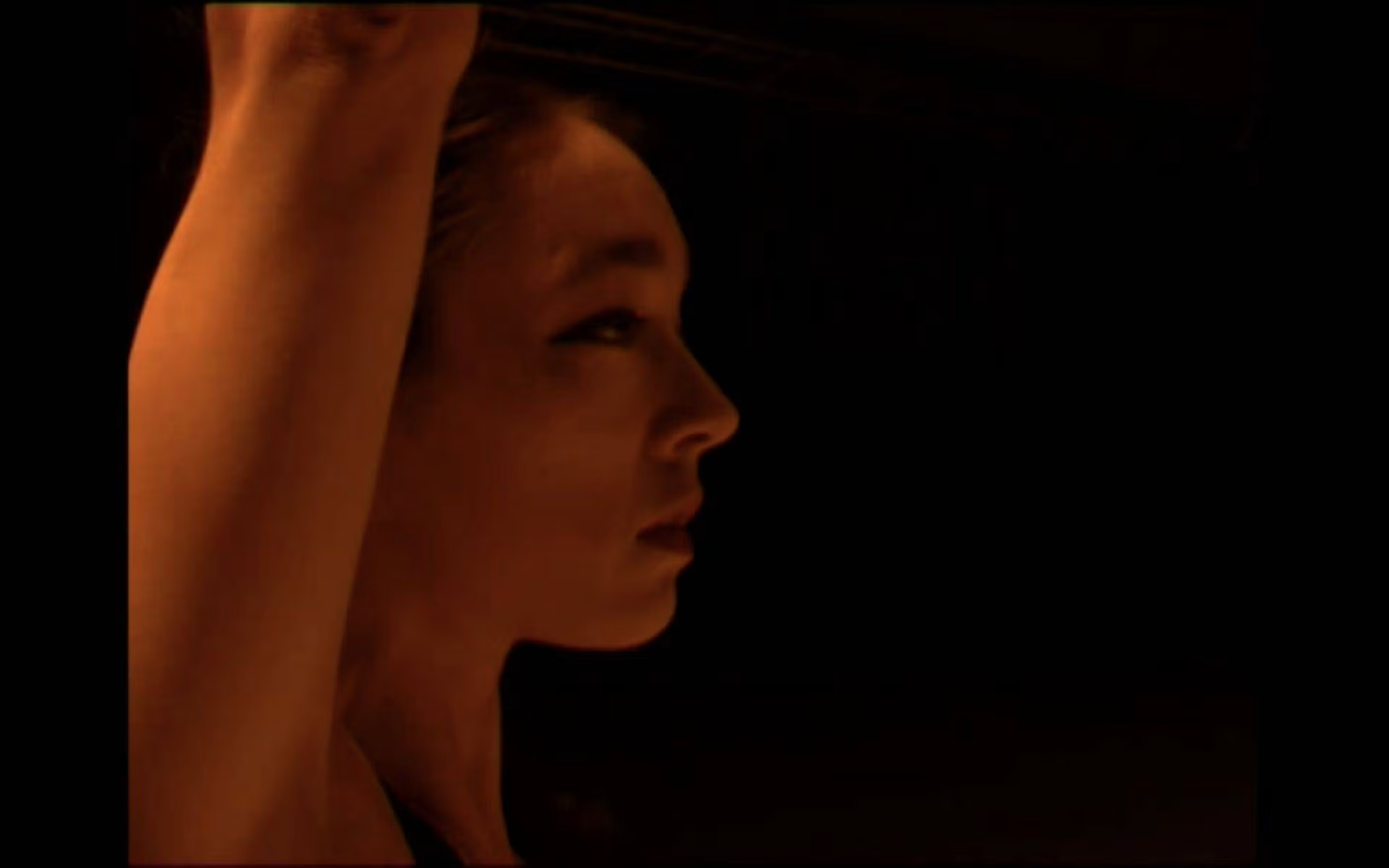
TIME

filmstill reis Moskou<->Vladiwostok->/ Japan / super 8 camera
De Tijd / Time
In 1981, Louis Andriessen composed his masterpiece De Tijd.
The heartbeat placed in the hands of the composer...
In 2002, Betsy Torenbos asked whether she could create a choreography to this
composition. Louis gave his blessing. This led to a dance and choreography within a multimedia context with orchestra (2005 & 2006, Dag in de Branding / Royal Conservatoire).
Is it time for a revival with orchestra and dance/choreography in Japan? It was one of the last conversations Betsy had with Louis about this music in 2019, just before he got ill. De Tijd is inspired by Japanese gagaku, 11th century court music!
The documentary The time of Louis Andriessen
The central figure in the film is Louis Andriessen. His personal life was closely intertwined with his life as a composer: he lived for music and for love. He often said, with characteristic modesty, “I can do nothing else.” In the podcasts, younger generations unravel the secrets of this master composer. What does his work mean to them? What do we learn about the human being behind the music?
Through in-depth conversations in 2024 and 2025 a rich and accessible portrait emerges of an artistic era with international influence. Younger generations reflect as well on how Andriessen shaped them and how his ideas continue to resonate worldwide in new music and interdisciplinary work. The diversity of perspectives—composers, musicians, choreographers, filmmakers, and conductors—creates a polyphonic and layered portrait of the times.
His life was defined by artistic making, marked by great openness and curiosity about the world around him. We discover the person behind the masterpiece: rebellious, loving, curious, and uncompromising.
Through the intimate nature of audio and one-on-one conversations, a depth is achieved that is rarely reached in written sources.
De Tijd, Grand Theatre, Groningen, 2005, CD
Film: Betsy Torenbos & Treva Wurmfeld, camera: Tarek
https://vimeo.com/1070776417
De Tijd, Festival in de Branding, The Hague, 2006, with orchestra Royal Conservatory - conductor Clark Rundell
https://www.dagindebranding.nl/programma-item/2-12-2006-clark-rundell-dirigent-4851/

filmstill reis Moskou<->Vladiwostok->/ Japan / super 8 camera
De Tijd of Louis Andriessen (1981)
quis tenebit illud et figet illud, ut paululum stet, et paululum rapiat splendorum semper stantis aeternitatis
"Who will hold the (heart) and affirm it so that it can stand still for a moment and briefly grasp the shine of the ever-still eternity?"
Andriessen completed the composition De Tijd in 1981 based on texts by Augustine. The piece was as well inspired by gagaku and his father Hendrik Andriessen. The piece was dedicated to love Josine van Droffelaar..
It was the third in a trilogy of true musical giants: De Staat (1976) based on Plato's text and Mausoleum (1979) based on Bakunin's text. Three works that not only manifest themselves grandly in length and require a large, unconventional ensemble but also tackle ambitious themes. It was precisely the theme of De Tijd that gave Andriessen many headaches: what is time? The inspiration for the piece was clear in his mind: "a unique experience that gave me the feeling that time had ceased to exist, the feeling of an eternal moment. It was more than perfect calmness, it was an euphoria so strong that I later decided to make a piece about it," Andriessen once shared in an interview with his friend and colleague Elmer Schönberger.
Louis Andriessen's Time
Documentary and Podcasts
Betsy Torenbos and co-director Bianca van Riemsdijk are responsible for this documentary and the accompanying podcasts.
Interviews
Interviews conducted by Betsy Torenbos in 2024, 2025 and 2026 with:
Beppie Blankert, Oscar Bettison, Gerard Bouwhuis, Hans Dagelet, David Dramm, Nora Fischer, Paul Gallis, Monica Germino, Frits van den Haspel, Heleen Hulst, Rozalie Hirs, Govert Jurriaanse, Renee Jonker, Manoj Kamps, Matthias Kassel (Sacher Stiftung Basel), Yiannis Kyriakidis, Claron Mac Fadden, Frank van Merwijk, Kate Moore, Tomoko Mukaiyama, Henk van der Meulen, Seung-Won Oh, Martijn Padding, Jan Panis, Gon Brinkman-Strazza, Patricio Wang, Clark Rundell, Frank Scheffer, Elmer Schönberger, Ernestine Stoop, Betsy Torenbos (interviewed by Bianca van Riemsdijk), Calliope Tsupaki, Max van Platen, Diderik Wagenaar, Patricio Wang, Cristina Zavaloni, Mirjam Zegers, Bob Zimmerman, Heidrun Ziems (Sacher Stiftung Basel).
Italy, 2026: Marina Mahler, Tonino Battista, Guido and Gon Strazza.
Japan, 2026: Hitomi Nakamura, Mayumi Miyata, Hideaki Bunno.
Edited and adapted into podcasts in 2026/2027.
The Netherlands — Royal Conservatoire The Hague, Spring 2026
Filmed Workshop — 25 February 2026Collaboration with the Royal Conservatoire The Hague. Under the direction of Renee Jonker, eight students will explore the scores of Hoketus and De Tijd.
Filmed Workshop — 2 March 2026Collaboration with the Royal Conservatoire The Hague. Under the direction of Diderik Wagenaar and Martijn Padding, eight students will explore the score of De Tijd.
Japan
At the end of 2026, we will travel to Japan for the final filming of the documentary.
Students of Gagaku at Kunitachi College of Music will be introduced to Andriessen's work from 1981.
Louis Andriessen's generosity and genius offer a message to today's younger generation: collaboration, openness, democratisation, discipline, rebelliousness, and, above all, an immense capacity for love. As Louis himself said: “Everything you have to do in order to get to know yourself is worthwhile.”
The influence of Louis Andriessen's (1939–2021) music has extended far beyond the borders of the Netherlands. Now that he has passed away, we wish to bring his work into contact with younger generations. At the end of 2019, Betsy Torenbos spoke with Louis about Japan and his composition De Tijd (1981), which was inspired by the centuries-old Japanese musical tradition of Gagaku. It is now time to introduce this work to a new generation of musicians and composers.
In 1970, Louis travelled to Japan with Jeanette Yanikian for the World Expo in Osaka. Louis and Jeanette lived together in Amsterdam for more than fifty years. She was his great love, his critic, and his muse. They are buried together at Zorgvlied Cemetery in Amsterdam.
During his time in Japan, Louis encountered the composer Toru Takemitsu, the eleventh-century tradition of Gagaku, the Zen garden of Ryoan-ji, Zen Buddhism, Noh theatre, and Kabuki. In 2000, De Tijd was performed once in Tokyo at Tokyo Opera City Concert Hall. Louis had been invited as a jury member for Composium 2000, founded by Toru Takemitsu, on the recommendation of Luciano Berio.
2029
In 2029, Louis Andriessen would have turned 90. We hope that this anniversary year will inspire numerous celebrations and events around the world — from Tokyo, via Rome and Amsterdam, to London and New York — centred around his masterpiece De Tijd, composed in 1981.
Acknowledgements
With thanks to Claire Pijman, Carolijn Borgdorff (Moondocs), Stichting Jaap Harten Fonds, Sacher Stiftung Basel, Boosey & Hawkes, Clark Rundell, Yannis Kyriakides, Noriko Koide, Marc van Roon, Taka Ozawa and Toshiya Watanabe, and Kamei Tomoko.
Special thanks to the Royal Conservatoire The Hague, in particular Renee Jonker and Martijn Padding, for their collaboration to date.
Toru Takemitsu
The Tōru Takemitsu Composition Award
The Tōru Takemitsu Composition Award is an international competition for young composers, established in 1997 by the Tokyo Opera City Cultural Foundation to promote innovative orchestral music and honour the legacy of the Japanese composer Tōru Takemitsu, who served as the award’s first Artistic Director.
Guided by Takemitsu’s principles of “Prayer, Hope and Peace” and “Window to the Future,” the award encourages emerging composers from around the world to create new works that contribute to the development of contemporary musical culture.
Selected compositions receive premiere performances, recordings, and opportunities for international exposure, fostering a dialogue between traditional and modern forms of musical expression and continuing Takemitsu’s vision of music as a force for hope and renewal.
Development and Changes
Following the first cycle, held from 1997 to 1999, during which Tōru Takemitsu personally selected the members of the jury, the award entered its second cycle (2000–2002). During this period, jury members were recommended by their predecessors: Louis Andriessen in 2000, Oliver Knussen in 2001, and Joji Yuasa in 2002.
Advisory panels were also introduced during this period to support the selection process, laying the foundations for subsequent developments and expansions of the award.
Louis Andriessen Platform
 Copyright 2026 Stichting Be-wonder